

Journal Publications
-
[24.] K. Sabo, Center-based $l_1$-clustering method, International Journal of Applied Mathematics and Computer Science, 24(2014), 151-163
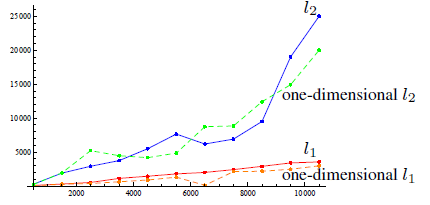 ABSTRACT:
In this paper, we consider the $l_1$-clustering problem for a data-points set
$\mathcal{A}=\{a^i\in\R^n\colon i=1,\dots,m\}$ which should be partitioned into
$k$ disjoint nonempty subsets $\pi_1,\dots,\pi_k$, $1\leq k\leq m$. In that
case, the objective function does not have to be either convex or differentiable
and generally it may have many local or global minima. Therefore, it becomes a
complex global optimization problem.A method for searching for a locally optimal
solution is proposed in the paper, convergence of the corresponding iterative
process is proved and a corresponding algorithm is also given.The method is
illustrated by and compared with some other clustering methods, especially with
the $l_2-$clustering method, which is also known in literature as a smooth
$k-$means method, on a few typical situations, such as the presence of outliers
among the data and clustering of incomplete data. Numerical experiments show in
this case that the proposed $l_1-$clustering algorithm is faster and gives
significantly better results than the $l_2-$clustering algorithm.
-
-
[23.] R. Scitovski, K. Sabo Analysis of the k-means algorithm in the case of data points occurring on the border of two or more clusters, Knowledge-Based Systems, 57(2014), 1-7
 ABSTRACT:
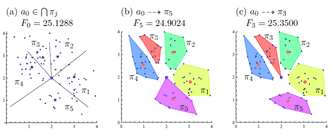
In this paper, the well-known $k$-means algorithm for searching for a locally
optimal partition of the set $\mathcal{A}\subset\R^n$ is analyzed in the case if
some data points occur on the border of two or more clusters. For this special
case, a useful strategy by implementation of the $k$-means algorithm is
proposed.
-
[22.] K. Sabo, R. Scitovski, Interpretation and optimization of the k-means algorithm, Applications of Mathematics, 2013
 ABSTRACT:
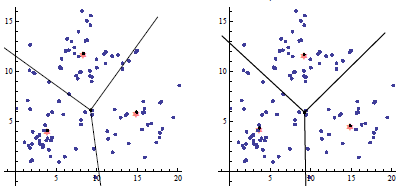
The paper gives a new interpretation and a possible optimization of the
well-known $k$-means algorithm for searching for a locally optimal partition of
the set $\mathcal{A}=\{a_i\in\R^n:i=1,\dots,m\}$ which consists of $k$ disjoint
nonempty subsets $\pi_1,\dots,\pi_k$, $1\leq k\leq m$. For this purpose, a new
\emph{divided $k$-means algorithm} was constructed as a limit case of the known
\emph{smoothed k-means algorithm}. It is shown that the algorithm constructed in
such way coincides with the $k$-means algorithm if during the iterative
procedure no data points appear in the Voronoi diagram. If in the partition
obtained by applying the \emph{divided $k$-means algorithm} there are data
points lying in the Voronoi diagram, it is shown that the obtained result can be
improved further.
-
-
[21.] K. Sabo, R. Scitovski, I. Vazler, One-dimensional center-based $l_1$-clustering method, Optimization Letters, 7 (2013), 5-22
-
 ABSTRACT:
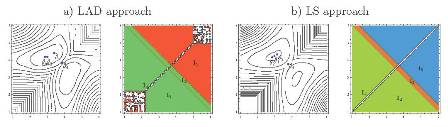
Motivated by the method for solving center-based Least Squares -
clustering problem (Kogan(2007), Teboulle(2007)), we construct a
very efficient iterative process for solving a one-dimensional
center-based $l_1$ -clustering problem, on the basis of which it
is possible to determine the optimal partition. We analyze the
basic properties and convergence of our iterative process, which
converges to a stationary point of the corresponding objective
function for each choice of the initial approximation. Given is
also a corresponding algorithm, which in only few steps gives a
stationary point and the corresponding partition. The method is
illustrated and visualized on the example of looking for an
optimal partition with two clusters, where we check all
stationary points of the corresponding minimizing functional.
Also, the method is tested on the basis of large numbers of data
points and clusters and compared with the method for solving the
center-based Least Squares - clustering problem described in
Kogan(2007) and Teboulle (2007).
-
-
[20.] R. Grbić, K. Scitovski, K. Sabo, R. Scitovski, Approximating surfaces by the moving least absolute deviations method, Applied Mathematics and Computations, 219(2013), 4387-4399
-
-
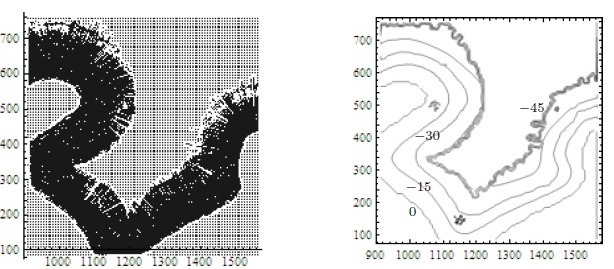 ABSTRACT:
In this paper we are going to consider the problem of global
data approximation on the basis of data containing outliers. For
that purpose a new method entitled the Moving Least Absolute
Deviations method is proposed. In the region of data in the
network of knots weighted least absolute deviations local planes
are constructed by means of which a global approximant is
defined. The method is tested on the well known Franke's
function. An application in gridding of sonar data is also shown
-
-
[19.] T. Marošević, K. Sabo, P. Taler, A mathematical model for uniform distribution voters per constituencies, Croatian Operational Research Review, 4(2012); 53-64.
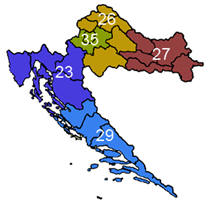 ABSTRACT: This paper
presents two different approaches on the basis of which it is possible to
generate constituencies. The first one is based on
cluster analysis by means of which one can get compact constituencies having an approximately equal number of voters. An optimal number of constituencies can be obtained by using this method. The second approach is based on partitioning the country to several areas with respect to territorial integrity of bigger administrative units. Natural units obtained in this way will represent constituencies which do not necessarily have to have an approximately equal number of voters. Each constituency is associated with a number of representatives that is proportional to its number of voters, so the problem is reduced to the integer approximation problem. Finally, these two approaches are combined and applied on the Republic of Croatia.
-
-
-
[18.] D. Vincek, K. Sabo, G. Kušec, G. Kralik, I. Đurkin, R. Scitovski, Modeling of pig growth by S-function – least absolute deviation approach for parameter estimation, Archiv Tierzucht / Archives Animal Breeding, 55(2012), 4, 364-374
-
 ABSTRACT:
The aim of this study was to determine a mathematical model
which can be used to describe the growth
of the pig. The study was conducted on 60 pigs (30 barrows and
30
gilts) in the interval between the age of 49 and 215 days. All
animals were weighed
at 49th
day after birth. For the purpose of growth measurements pigs
were weighted
every
7th day during the experiment. Every 21th day four pigs were
selected for the
slaughter according to average live weight (LW). By applying the
generalized logistic
function, the growth of live weight and tissues were described.
Thereby optimal
parameters in the model were estimated on the basis of
measurement data by means
of the
robust Least Absolute Deviations (LAD) principle. The prediction
of optimum
slaughter age/weight, on the basis of such model represent a
contribution of this paper
to the
practice.
- [17.] K. Sabo, R. Scitovski, P. Taler, Uniform distribution of the number of voters per constituency on the basis of a mathematical model, Hrvatska i komparativna javna uprava, (14) 2012, 229-249
-
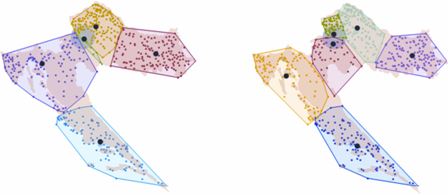 ABSTRACT:
This paper presents a mathematical model on the basis of which
it is possible to define maximum compact well-separated
constituencies, which can vary with respect to the number of
voters by at most 5%. The model is set up so as not to favor any
political option and it is based on the application of
cluster analysis, taking into account the rule according to
which constituencies should have roughly the same number of
voters. The method is illustrated on the example of the
available data from 2007, sothat distribution of constituencies
obtained in this way should not be taken as the final solution
proposal, but only as a demonstration of the possibilities
offered by this methodology. Under the current law, the
elections in Croatia are carried out in 10 constituencies. In
this paper, several approaches known from the literature are
proposed on the basis of which it is possible to determine the
appropriate number of constituencies, which retain the property
of maximum internal compactness and satisfactory
well-separation.
- [16.] I. Svalina, K. Sabo, G. Šimunović, Machined Surface Quality Prediction Models Based on Moving Least Squares and Moving Least Absolute Deviations Methods, International Journal of Advanced Manufacturing Technology, 57(2011), 1099-1106
-
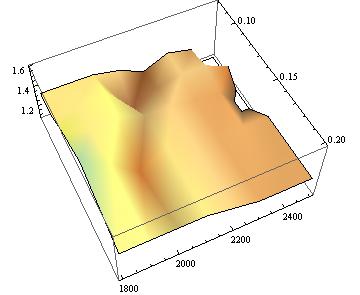 ABSTRACT: Surface roughness is often taken as an indicator of the quality
of machined work pieces. Achieving the desired surface quality is of great
importance for the product function. The paper analyses the influence of
the cutting depth, feed rate and number of revolutions on surface roughness.
The obtained results of experimental research conducted on the work piece
"diving manifold", were used to determine the coefficients by different
numerical methods of the same prediction model. The results of surface roughness
provided by the prediction functions generated in this work were compared
with the results of surface roughness obtained by using neural networks. The
assessment of surface roughness provided by models and neural networks can
facilitate the work of less experienced technologists and thus shorten the
time of production technology preparation. The obtained results show that
the total mean square deviation in models obtained by the application of the
moving linear least squares and the moving linear least absolute deviations
methods is nevertheless considerably higher than by the application of
neural network method.
- [15.] D. Vincek, G. Kralik, G. Kušec, K. Sabo, R. Scitovski, Application of growth functions in the prediction of live weight of domestic animals, Central European Journal of Operations Resarch, (20)2012, 719-733
-
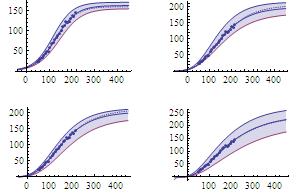 ABSTRACT: We consider several most frequently used growth functions with the aim
of predicting live weight of domestic animals. Special attention is paid to the
possibility of estimating well the saturation level of animal weight and
defining life cycle phases based on animal weight. Parameters of the growth
function are most often estimated on the basis of measurement data by applying
the Least Squares (LS) principle. These nonlinear optimization problems very
often refer to a numerically very demanding and unstable process. In practice,
it is also possible that among the data there might appear several measurement
errors or poor measurement samples. Such data might lead not only to unreliable,
but very often to wrong conclusions. The Least Absolute Deviations (LAD)
principle can be successfully applied for the purpose of detecting and
minorizing the effect of such data. On the other hand, by using known properties
of LAD-approximation it is possible to significantly simplify the minimizing
functional, by which parameters of the growth function are estimated.
Implementation of two such possibilities is shown in terms of methodology.
- [14.] K. Sabo, R. Scitovski, I. Vazler, Searching for a best LAD-solution of an overdetermined system of linear equations motivated by searching for a best LAD-hyperplane on the basis of given data, Journal of Optimization Theory and Applications, 149 (2011), 2, 293-314
-
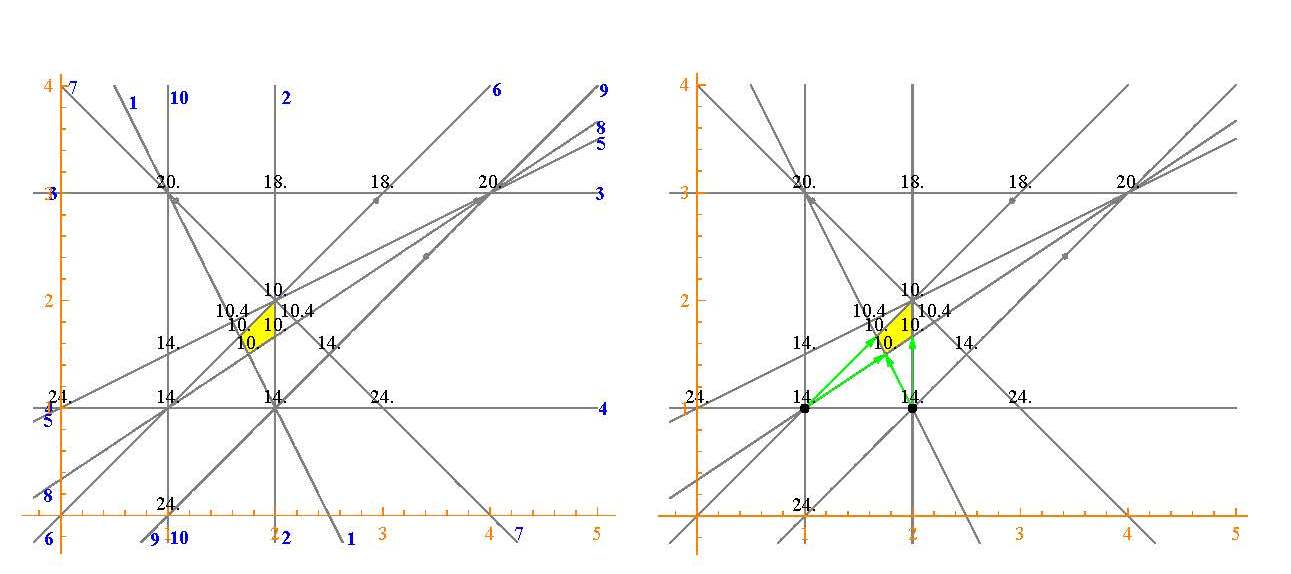 ABSTRACT: (pdf)
- [13.] I. Vazler, K. Sabo, R. Scitovski, Weighted median of the data in solving least absolute deviations problems, Communications in Statistics – Theory and Methods, (41) 2012, 1455-1465
-
ABSTRACT: We consider the weighted median problem for a given set of data and analyze its main properties. As an illustration, an efficient method for searching for a weighted Least Absolute Deviations (LAD)-line is given, which is used as the basis for solving various linear and nonlinear LAD-problems occurring in applications. Our method is illustrated by an example of hourly natural gas consumption forecast.
- [12.] K. Sabo, R. Scitovski, I. Vazler, M. Zekić-Sušac, Mathematical models of natural gas consumption, Energy Conversion and Management, 52(2011), 1721-1727.
-
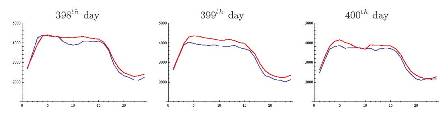 ABSTRACT: In this paper we consider the problem of natural gas consumption
hourly forecast on the basis of hourly movement of temperature and natural gas
consumption in the preceding period. There are various methods and approaches
for solving this problem in the literature. Some mathematical models with linear
and nonlinear model functions relating to natural gas consumption forecast with
the past natural gas consumption data, temperature data and temperature forecast
data, are mentioned. The methods are tested on concrete examples referring to
temperature and natural gas consumption for the area of the city of Osijek
(Croatia) from the beginning of the year 2008. The results show that most
acceptable forecast is provided by mathematical models in which natural gas
consumption and temperature are related explicitly.
- [11.] M. Benšić, K. Sabo, Estimating a uniform distribution when data are measured with a normal additive error with unknown variance. Statistics - A Journal of Theoretical and Applied Statistics, 44 (2010), 235-246.
-
ABSTRACT: The problem of estimating the width of a symmetric uniform distribution on the line together with the error variance, when data are measured with normal additive error, is considered. The main purpose is to analyze the maximum likelihood estimator and to compare it with the moment method estimator. It is shown that this two-parameter model is regular so that the maximum likelihood estimator is asymptotically efficient. Necessary and sufficient conditions are given for the existence of the maximum likeli- hood estimator. As numerical problems are known to frequently occur while computing the maximum likelihood estimator in this model, useful suggestions for computing the maximum likelihood estimator are also given.
- [10.] R. Cupec, R. Grbić, K. Sabo, R. Scitovski, Three points method for searching the best least absolute deviations plane, Applied Mathematics and Computation. 215 (2009) , 3; 983-994
-
ABSTRACT: In this paper a new method for estimation of optimal parameters of a best least absolute deviations plane is proposed, which is based on the fact that there always exists a best least absolute deviations plane passing through at least three different data points. The proposed method leads to a solution in finitely many steps. Moreover, a modification of the aforementioned method is proposed that is especially adjusted to the case of a large number of data and the need to estimate parameters in real time. Both methods are illustrated by numerical examples on the basis of simulated data and by one practical example from the field of robotics.
- [9.] K. Sabo, M. Benšić, Border estimation of a disc observed with random
errors solved in two steps, Journal of Computational and Applied Mathematics.
229 (2009) , 1; 16-26
ABSTRACT: The problem of estimating the boundary of a uniform distribution on a disc is considered when data are measured with normally distributed additive random error. The problem is solved in two steps. In the first step the domain is subdivided into thin slices and the endpoints of slices are obtained within the framework of a corresponding one-dimensional problem. For the estimations implemented in that step the moment method and the maximum likelihood method are used. As there are numerical problems with calculating the variance of the estimator in the maximum likelihood approach, its good approximation is also given. In the second step the obtained endpoints are used to estimate the boundary using the total least-squares curve fitting procedure. A necessary and sufficient condition for the existence of the total least-squares solution is also given. Finally, simulation results are presented.
- [8.] K. Sabo, R. Scitovski, The best least absolute deviations line-properties and two efficient methods for its derivation, ANZIAM Journal. 50 (2008) , 2; 185-198
-
ABSTRACT: Given a set of points in the plane, the problem of existence and finding the least absolute deviations line is considered. The most important properties are stated and proved and two efficient methods for finding the best absolute deviations line are proposed. Compared to other known methods, our proposed methods proved to be considerably more efficient
- [7.] M. Benšić, K. Sabo, Border Estimation of a Two-dimensional Uniform Distribution if Data are Measured with Additive Error, Statistics - A Journal of Theoretical and Applied Statistics. 41 (2007) , 4; 311-319
-
ABSTRACT: The paper considers estimation of the boundary of an elliptical domain when the data without a measurement error are distributed uniformly on this domain but are superimposed by random errors. The problem is solved in two phases. In the first phase the domain is subdivided into thin slices and the endpoints of these slices are estimated within the framework of a corresponding one-dimensional problem. In the second phase the estimated endpoints are used to estimate the boundary using the total least squares curve fitting procedure.
- [6.] K. P. Hadeler, D. Jukić, K. Sabo, Least squares problems for Michaelis Menten kinetics. Mathematical Methods in the Applied Sciencies. 30 (2007) , 11; 1231-1241
-
ABSTRACT: The Michaelis-Menten kinetics is fundamental in chemical and physiological reaction theory. The problem of parameter identification, which is not well-posed for arbitrary data, is shown to be closely related to the Chebyshev sum inequality. This inequality yields sufficient conditions for existence of feasible solutions both for non-linear and for linear least squares problems. The conditions are natural and practical as they are satisfied if the data show the expected monotone and concave behavior.
- [5.] D. Jukić, K. Sabo, R. Scitovski, Total least squares fitting Michaelis-Menten enzyme kinetic model function. Journal of Computational and Applied Mathematics. 201 (2007) , 1; 230-246
-
ABSTRACT: The Michaelis-Menten enzyme kinetic model $f(x ; a, b)=ax/(b+x)$, $a, b>0$, is widely used in biochemistry, pharmacology, biology and medical research. Given the data $(p_i, x_i, y_i)$, $i=1, \ldots, m$, $m\geq 3$, we consider the total least squares (TLS) problem for the Michaelis-Menten model. We show that it is possible that the TLS estimate does not exist. As the main result, we show that the TLS estimate exists if the data satisfy some natural conditions. Some numerical examples are included.
- [4.] M. Benšić, K. Sabo, Estimating the width of a uniform distribution when data are measured with additive normal errors with known variance. Computational Statistics & Data Analysis. 51 (2007) , 9; 4731-4741
-
ABSTRACT: The problem of estimating the width of the symmetric uniform distribution on the line when data are measured with normal additive error is considered. The main purpose is to discuss the efficiency of the maximum likelihood estimator and the moment method estimator. It is shown that the model is regular and that the maximum likelihood estimator is more efficient than the moment method estimator. A sufficient condition is also given for the existence of both estimators.
- [3.] D. Jukić, R. Scitovski, K. Sabo, A review of existence criteria for parameter estimation of the Michaelis-Menten regression model. Annali dell'Universita' di Ferrara. 53 (2007) ; 281-291
-
ABSTRACT: In this paper we consider the least squares (LS) and total least squares (TLS) problems for a Michaelis-Menten enzyme kinetic model $f(x ; a, b)=ax/(b+x)$, $a, b>0$. In various applied research such as biochemistry, pharmacology, biology and medicine there are lots of different applications of this model. We will systematize some of our results pertaining to the existence of the LS and TLS estimate, which were proved in papers [16] and [17]. Finally, we suggest a choice of good initial approximation and give one numerical example.
- [2.] R. Scitovski, G. Kralik, K. Sabo, T. Jelen, A mathematical model of controlling the growth of tissue in pigs. Applied Mathematics and Computation. 181 (2006) , 2; 1126-1138
-
ABSTRACT: A mathematical model of controlling the growth of tissues in pigs is described in this paper. In that sense, a method is given by which it is possible to periodically and very accurately estimate live pig weight of backfat based upon measurements done by ultrasound. These estimations will be used for the purpose of predicting growth of backfat in live pigs. Backfat weight is estimated on the basis of measurements done by using the Moving Total Least Squares Method, whereas estimation of live pig backfat growth is done by using a generalized logistic function, whose parameters are estimated by means of the Least Squares Method. Since thereby the Hessian of the corresponding minimizing function is very close to a singular matrix, an additional problem analysis was necessary .
- [1.] K. Sabo, A. Baumgartner, One method for searching the best discrete TL_p approximation. Mathematical Communications - Supplement. 1 (2001) , 1; 63-68.
-
ABSTRACT: On the basis of the given data we will show how efficiently the best TL_p natural cubic spline can be found. Cases p=1, 2 will be especially considered. The best TL_1 spline is of special interest because it is insensitive to the so called outliers, although for its constuction it is necessary to carry out a multidimensional minimization of an undifferetiable function. For that purpose Nelder-Meads Downhill Simplex Method is used. For the calculation of the distance from the data-point to the spline the Brent Method for onedimensional minimization is used. Also, based on the described methods we will show generating of the optimal curve of the second order on the basis of the given data. The method is illustrated with examples developed on the basis of our own programs written in the C programming language
Conference Proceedings
- G. Kralik, K. Sabo, R. Scitovski, I. Vazler, Solving parameter
identification problem by the moving least absolute deviations method,
Proceedings of the 12th International Conference on Operational Research,
Pula, 2010, 297-307.
- G. Kušec, I. Kuzmanović, K. Sabo, R. Scitovski, A new method for
searching an $L_1$ solution of an overdetermined system of linear equations and
applications, Proceedings of the 12th International Conference on
Operational Research, Pula, 2010, 309-319.
- I. Kuzmanović, K. Sabo, R. Scitovski, I. Vazler, The least absolute deviation linear regression: properties and two efficient methods, Aplimat-Journal of Applied Mathematics / Kováčová Monika (ur.). Bratislava : Slovak University of Technology in Bratislava, 2009. 227-240
- D. Jukić, R. Scitovski, A. Baumgartner, K. Sabo, Localization of the least squares estimate for two parameter regression models, Proceedings of the 10th International Conference on Operational Research KOI 2004 / Scitovski, Rudolf ; Jukić, Dragan (ur.). Osijek : Department of Mathematics, University of Osijek ; Croatian Operational Research Society, Zagreb, 2005. 165-174.
- D. Jukić, R. Scitovski, K. Sabo, Total least squares problem for the Hubbert function, Proceedings of the Conference on Applied Mathematics and Scientific Computing / Drmač, Zlatko ; Marušić Miljenko ; Tutek Zvonimir (ur.). Dordrecht : Springer, 2005. 217-234
- D. Jukić, K. Sabo, G. Bokun, Least squares problem for the Hubbert function, Proceedings of the 9th International Conference on Operational Research-KOI 2002 / Šorić, Kristina ; Hunjak, Tihomir ; Scitovski, Rudolf (ur.)
- I. Soldo, K. Sabo, Računanje udaljenosti točke do krivulje, Zbornik radova PrimMath 2003.
- K. Sabo, Generiranje TL_p spline-ova, Zbornik radova PrimMath[2001} / Ungar, Šime (ur.). Zagreb : Prirodoslovno-matematiči fakultet Sveučilišta u Zagrebu, 2002. (na CDROM-u). 235-243
Professional Papers
- K. Sabo, S. Scitovski, Lokacija objekata u ravnini, KoG,
Scientific and Professional Journal of Croatian Society for Geometry and
Graphics, prihvaćen za objavljivanje, 2011
- K. Sabo, R. Scitovski, I. Vazler, Grupiranje podataka:
klasteri, Osječki matematički list 10(2010), 2, 149-178
- M. Meštrović, K. Sabo, Grafička ilustracija pogreške u rješenju sustava linearnih jednadžbi. Osječka matematička škola 4 (2004) , 2; 87-94
- K. Sabo, K. Sabo, Prosti brojevi, Osječka matematička škola 3 (2003) , 1; 13-20
- K. Sabo, Minimizacija realne funkcije realne varijable. Osječka matematička škola 1 (2001) , 2; 109-118.